
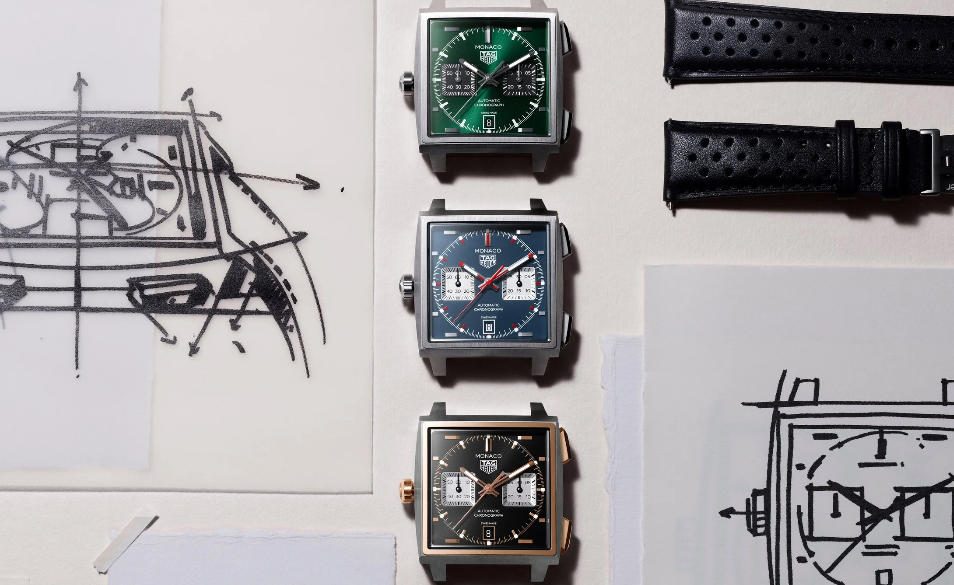
The 2026 TAG Heuer Monaco Chronograph represents one of the most significant updates to the square racing chronograph in years. Rather than abandoning the character that made the Monaco recognizable, TAG Heuer returned to several details associated with the original 1969 design while rebuilding the case, dial layout and movement around modern specifications.
For readers researching a TAG Heuer Monaco Chronograph replica, this new generation also creates a different set of details to examine. The 39mm Grade 5 titanium case, left-side crown, bi-compax dial, date at 6 o’clock and Calibre TH20-11 layout distinguish the 2026 references from many earlier modern Monaco models.
What Changed With the 2026 TAG Heuer Monaco?
At first glance, the formula remains unmistakably Monaco. The watch still has a square case,two chronograph pushers on the right and a strong connection with motorsport. Look more carefully, however, and the changes become substantial.
TAG Heuer redesigned the case around Grade 5 titanium and adjusted its geometry to improve ergonomics. The sides are more carefully shaped, the caseback has been reconsidered and the relationship between the case and strap has been refined.
More importantly for enthusiasts of the original Monaco, the crown returns to the left side of the case and the dial returns to a cleaner two-register arrangement.
Readers interested in the wider history of the square chronograph can explore our TAG Heuer Monaco replica guides for additional references from different generations.
2026 TAG Heuer Monaco Chronograph Specifications
| Feature | 2026 Monaco Chronograph |
|---|---|
| Case | Grade 5 titanium |
| Case size | 39mm |
| Thickness | 13.9mm |
| Lug distance | 22.5mm |
| Crystal | Sapphire |
| Water resistance | 100 metres |
| Movement | TAG Heuer Calibre TH20-11 automatic |
| Frequency | 28,800 vibrations per hour / 4Hz |
| Power reserve | Approx. 80 hours |
| Chronograph layout | Bi-compax |
| Crown position | 9 o’clock |
| Date | 6 o’clock |
| Strap | Black perforated calfskin leather |
The 39mm Grade 5 Titanium Case Deserves More Attention
The square silhouette may be familiar, but case construction is one of the most important changes on the new Monaco.
Grade 5 titanium reduces weight compared with a similarly proportioned steel case while retaining the strong geometric appearance expected from the Monaco. The material also allows TAG Heuer to combine fine brushing, polishing and sand-blasted surfaces across different areas of the case.
This is important when comparing a 2026 Monaco-style replica because simply reproducing a 39mm square outline is not enough. Small differences in side-wall curvature, lug geometry,caseback shape and thickness can significantly change how the watch looks and sits on the wrist.
Case details worth examining
- Overall 39mm square proportions
- Approximate 13.9mm thickness
- Shape and curvature of the case sides
- Transitions between brushed and polished surfaces
- Caseback profile
- Integration between the lugs and leather strap
- Position and proportions of the crown and chronograph pushers
Why the Left-Side Crown Matters
One of the defining details of the original automatic Monaco was its unusual crown position.With the winding crown located on the left side and the chronograph pushers on the right,the arrangement immediately separated the Monaco from more conventional racing chronographs.
Later Monaco generations did not always follow exactly the same configuration. The 2026 TH20-11 generation deliberately brings the crown back to 9 o’clock, strengthening the visual connection with the historic reference 1133.
On a replica, crown position is therefore only the first checkpoint. Diameter, depth,engraving, distance from the case and alignment with the pushers should also be examined.
The Return to a Cleaner Bi-Compax Dial
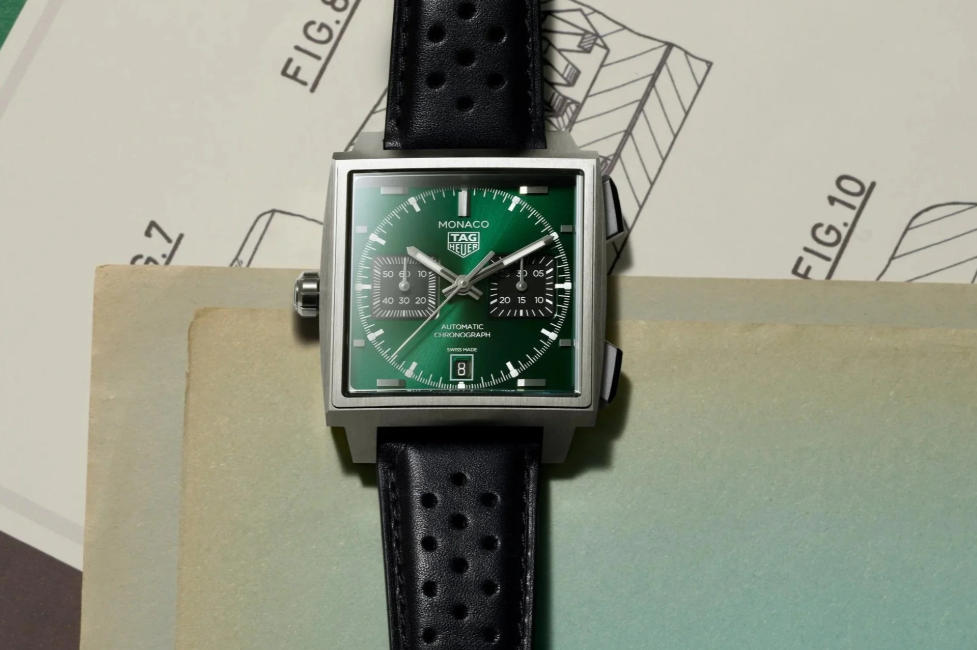
The 2026 Monaco also simplifies the dial architecture. Instead of a busier modern chronograph arrangement, the watch uses two principal registers positioned horizontally across the square dial.
The chronograph minute counter is positioned at 3 o’clock, while running seconds appears at 9 o’clock. The date window is moved to 6 o’clock, allowing it to sit independently rather than interfere visually with one of the registers.
This arrangement is important because the Monaco’s square case makes symmetry particularly easy to judge. If one register sits too high, too low or too close to the centre, the entire dial can appear unbalanced.
Dial details to compare
- Distance between the two registers
- Shape and dimensions of the square subdials
- Position of the date at 6 o’clock
- Alignment of horizontal hour markers
- Length of the central hands
- Chronograph seconds-hand alignment
- TAG Heuer or Heuer typography
- Minute-track spacing around the edge of the dial
Blue, Green and Black: Three Different Personalities
The 2026 core Monaco Chronograph was introduced in three notably different visual configurations.
Blue Monaco Chronograph
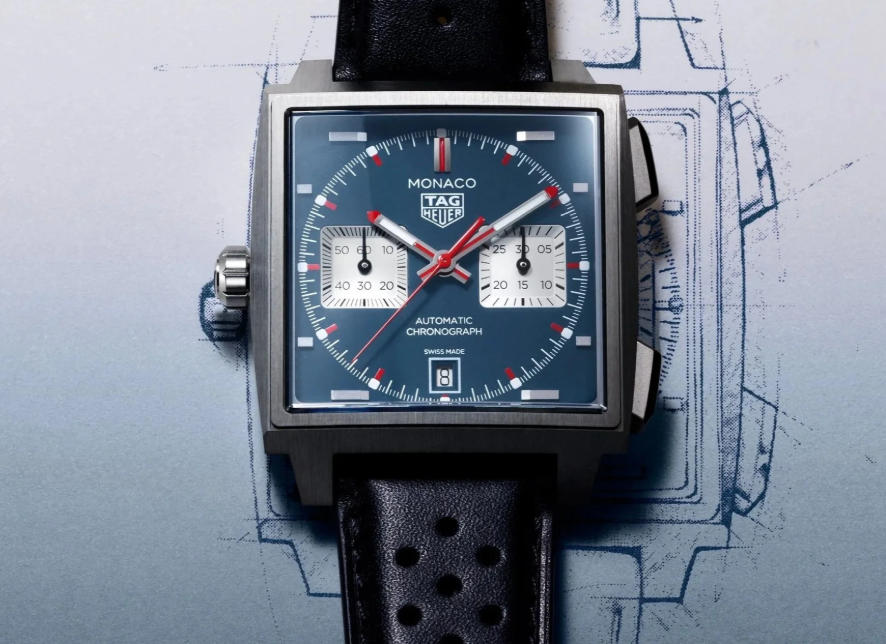
The blue version is the clearest historical reference. Its blue opaline dial, contrasting silver registers and red accents immediately recall the colour combination most closely associated with the Monaco’s motorsport history.
Because the dial contains several strongly contrasting colours, inaccuracies in subdial dimensions and red detailing can be relatively easy to spot.
Green Monaco Chronograph
The green reference takes a more contemporary approach. Its sunray-brushed and lacquered dial changes character as light moves across its surface, while black opaline counters create a darker contrast than the silver registers used on the blue version.
When comparing this configuration, photographs taken under several lighting conditions are more useful than a single heavily edited promotional image.
Black and Rose-Gold Monaco Chronograph
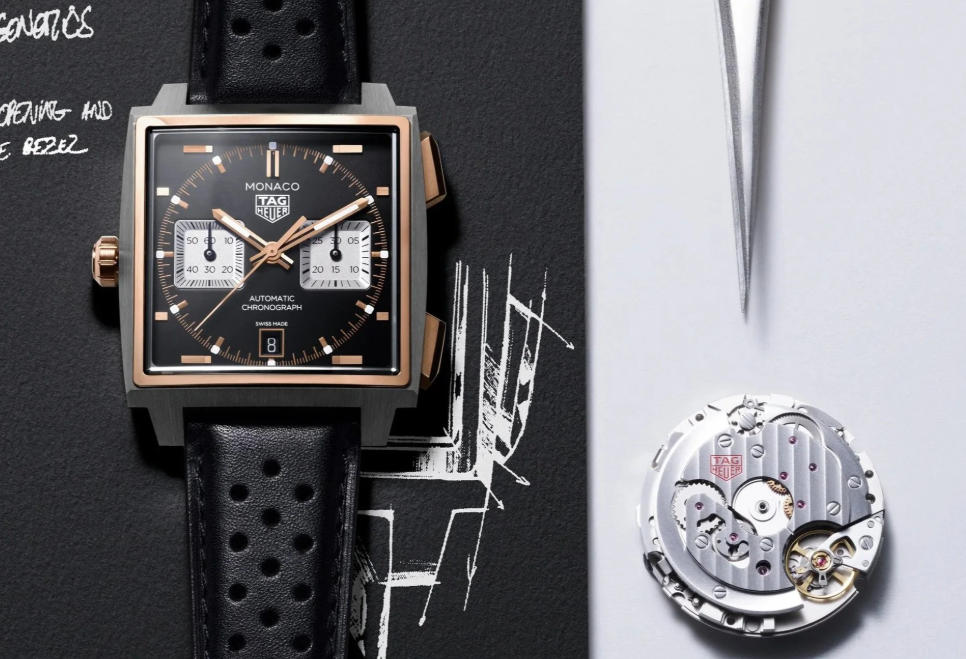
The third version combines Grade 5 titanium with solid 18K 5N rose-gold components.The black opaline dial, silver counters and gold-toned hands and indexes give the Monaco a more restrained and luxurious appearance.
Material colour becomes particularly important on this version. A simple gold-coloured coating will not necessarily reproduce the tone, surface finish or visual relationship between the original titanium and rose-gold elements.
The TH20-11 Is More Than a New Movement Name
The most important technical update is the Calibre TH20-11 automatic chronograph movement.It belongs to TAG Heuer’s modern in-house chronograph architecture but has been configured specifically to suit the Monaco’s heritage-driven layout.
The TH20-11 uses bidirectional automatic winding and provides approximately 80 hours of power reserve. It operates at 28,800 vibrations per hour, or 4Hz.
The movement can be viewed through the sapphire caseback, which means its architecture matters visually as well as mechanically.
Movement-related points worth checking
- Whether the movement is actually automatic
- Position of the winding crown
- Correct chronograph functions
- Running-seconds position
- 30-minute counter operation
- Chronograph reset accuracy
- Actual power reserve
- Movement thickness and its effect on case height
- Appearance through the sapphire caseback
A movement advertised using terms such as “TH20-11 clone” should therefore not automatically be assumed to duplicate the architecture or specifications of TAG Heuer’s original calibre.
Why Chronograph Functionality Is Especially Important
A Monaco is not simply a square three-hand watch with decorative registers. The chronograph is central to both its history and its visual identity.
This creates a challenge for replica versions because the dial layout must correspond with the functions provided by the movement underneath.
A watch can reproduce the appearance of the two subdials while assigning different functions to them. In other examples, one register may be decorative or behave differently from the original configuration.
For that reason, photographs alone cannot establish movement accuracy. The chronograph should be checked through a complete start, stop and reset cycle.
The Date Window Is a Small but Important Change
Moving the date to 6 o’clock improves the visual balance of the 2026 dial and separates the calendar display from the chronograph registers.
On the new generation, the date aperture is slightly angled and integrated into the lower portion of the dial. Its position relative to the central axis and surrounding minute track is therefore a useful comparison point.
Look closely at:
- Date-window dimensions
- Angle of the aperture
- Vertical centring of the numeral
- Date-wheel font
- Distance between the date window and lower dial edge
Sapphire Crystal and Caseback
The modern Monaco uses sapphire at both the front and rear. The front crystal remains a significant component of the Monaco’s appearance because the square crystal rises above a case with unusually strong edges and angles.
Crystal height and curvature can substantially change the side profile. A version with an excessively flat or thick crystal may still look convincing from directly above but noticeably different from an oblique angle.
The transparent rear also exposes movement differences that would remain hidden on a solid-caseback watch.
Perforated Racing Strap and Titanium Clasp
TAG Heuer pairs the core Monaco Chronograph with a black perforated calfskin leather strap, reinforcing its connection with classic racing chronographs.
The strap is secured by a Grade 5 titanium folding clasp. This combination also helps maintain the lightweight character created by the titanium case.
Strap and clasp details to examine
- Size and spacing of the perforations
- Leather thickness
- Stitching consistency
- Width where the strap meets the case
- Shape of the folding clasp
- Surface finishing on the titanium-style clasp
- Security of the double push-button mechanism
2026 Monaco vs. the Previous Modern Monaco
The differences between the 2026 model and previous modern Monaco references go well beyond colour.
| Area | Previous Modern Monaco | 2026 Monaco TH20-11 |
|---|---|---|
| Case concept | Earlier modern square architecture | Reworked ergonomic square case |
| Primary case material | Varied by reference | Grade 5 titanium |
| Crown | Varied by movement/reference | Left side at 9 o’clock |
| Dial layout | More modern configurations | Heritage-inspired bi-compax |
| Date | Different positioning depending on reference | 6 o’clock |
| Movement | Earlier Calibre 11 / Heuer 02 / TH20 variants | TH20-11 |
| Power reserve | Movement dependent | Approx. 80 hours |
Do Not Confuse the Monaco Chronograph With the Monaco Evergraph
TAG Heuer introduced more than one important Monaco at Watches and Wonders 2026. The standard Monaco Chronograph covered in this guide should not be confused with the
Monaco Evergraph.
The TH20-11 Monaco is the heritage-oriented core chronograph. The Evergraph is a separate, more experimental development built around another movement architecture and a different approach to chronograph operation.
This distinction matters when evaluating replica specifications. A seller or article that
combines TH20-11 specifications with Evergraph specifications is describing two different
watches as though they were one.
Why “1:1,” “AAA” and “Best Fake” Are Not Technical Specifications
Searches for this watch often include descriptions such as “1:1 TAG Heuer Monaco,” “AAA Monaco replica” or “best fake TAG Heuer.”
These expressions do not represent standardized independent quality grades. Two watches carrying exactly the same marketing label can use different movements, case materials,crystals, dials and chronograph layouts.
Readers browsing replica watches UK content should therefore compare observable specifications rather than assuming that a particular marketing term guarantees a defined level of construction.
| Area | What to Compare |
|---|---|
| Case | 39mm proportions, thickness, side curvature and finishing |
| Dial | Subdial position, markers, date window and printing |
| Crown | Left-side position, dimensions and alignment |
| Chronograph | Start, stop, reset and correct subdial functions |
| Movement | Architecture, winding, power reserve and thickness |
| Crystal | Shape, height and side profile |
| Strap | Perforations, leather thickness and clasp construction |
Common Details That Can Look Wrong
1. The square case is too bulky
Square watches react strongly to small proportional changes. Excessive thickness or straight,slab-like side walls can make a Monaco look substantially larger than its nominal measurement suggests.
2. The crown is incorrectly positioned
The left-side crown is one of the defining characteristics of the 2026 generation.Incorrect height or spacing becomes easy to notice from the side.
3. The subdials sit in the wrong position
Because the registers create a strong horizontal visual line across a square dial, even a small spacing error can affect the entire composition.
4. The date window is too large
An oversized date aperture can dominate the lower portion of the dial and reduce the cleaner symmetry that defines the new layout.
5. The movement forces a thicker case
Alternative chronograph movements can require additional vertical space. Checking side-profile photographs is therefore essential when overall proportions matter.
6. The crystal profile is incorrect
The Monaco’s sapphire crystal contributes significantly to its architectural appearance.Incorrect height or edge geometry is easier to see from a three-quarter angle than from above.
What Should You Compare First?
- Check the overall 39mm square case proportions.
- Compare case thickness and side curvature.
- Confirm that the crown is positioned at 9 o’clock.
- Examine the spacing of the two chronograph registers.
- Check the date position and typography at 6 o’clock.
- Test the chronograph start, stop and reset functions.
- Identify the actual movement rather than relying only on a TH20-11 marketing label.
- Compare the sapphire crystal and caseback from several viewing angles.
- Inspect the perforated leather strap and folding clasp.
Frequently Asked Questions
What size is the 2026 TAG Heuer Monaco Chronograph?
The new core Monaco Chronograph uses a 39mm square case.
What is the case made from?
The blue and green references use Grade 5 titanium. A two-tone version combines Grade 5 titanium with solid 18K 5N rose-gold components.
What movement powers the 2026 Monaco?
The standard 2026 Monaco Chronograph uses TAG Heuer’s automatic Calibre TH20-11.
How long is the power reserve?
TAG Heuer specifies approximately 80 hours.
Where is the crown?
The winding crown is positioned on the left side of the case at 9 o’clock, while the chronograph pushers remain on the right.
Where is the date?
The date aperture is positioned at 6 o’clock.
Is the 2026 Monaco Chronograph the same as the Evergraph?
No. They are separate Monaco models with different movement architectures and technical goals.
Does “1:1 Monaco” describe an official quality level?
No. “1:1,” “AAA,” “best fake” and similar expressions are marketing terms rather than standardized technical classifications.
Final Thoughts
The 2026 TAG Heuer Monaco Chronograph succeeds by changing important technical details without removing the characteristics that make a Monaco instantly recognizable.
The 39mm Grade 5 titanium case improves the physical architecture, the left-side crown strengthens the historical connection, the bi-compax dial restores visual clarity and the TH20-11 provides a modern 80-hour automatic chronograph platform.
For readers researching a 2026 TAG Heuer Monaco Chronograph replica,these characteristics provide a much stronger comparison framework than generic labels such as “1:1” or “AAA.”
Start with the case geometry and dial layout, then examine chronograph functionality,movement construction, crystal profile and strap integration. The Monaco is a visually simple watch in outline, but its unusual square proportions mean small inaccuracies can become surprisingly obvious once the details are compared side by side.