
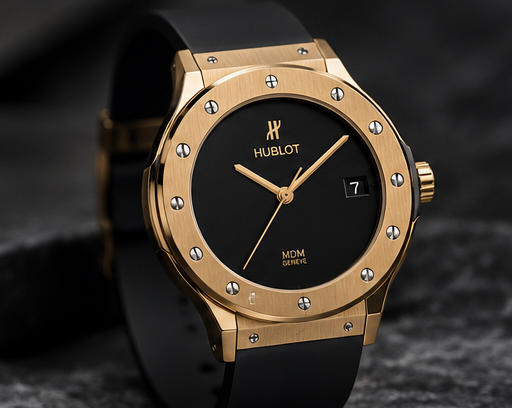
Hublot has spent much of the last two decades being associated with watches that are large, highly technical and deliberately difficult to overlook. Big Bang models in ceramic, sapphire, carbon fibre and brightly coloured materials have become so familiar that it is easy to forget how restrained the brand looked at the beginning. The Classic Fusion Tributo is interesting precisely because it strips much of that modern identity away and returns to the simple idea that established Hublot in 1980.
Carlo Crocco’s original watch was unusual because it placed a precious-metal case on a black rubber strap at a time when luxury watchmaking still tended to keep those worlds apart. Today that combination no longer feels provocative, partly because Hublot spent decades turning material contrast into a central part of its identity. The Tributo therefore does not need to imitate every detail of the original watch to make its point. The connection is already visible in the proportions, bezel, exposed lugs and rubber strap.
The modern case measures 38mm rather than the original 36mm. That small increase is more important than it sounds. A completely faithful 36mm recreation might have appealed to purists, but 38mm gives the watch enough presence to sit comfortably in Hublot’s current catalogue without making it feel oversized. It remains noticeably more restrained than the Big Bang, and that restraint is essential to the character of the watch.
For readers following replica watches UK, the Tributo is also a particularly useful model to study. There are no complicated dial displays or oversized pushers to distract from the basic architecture. If the bezel is too thick, the screws are incorrectly spaced or the strap attachment is wrong, those differences become obvious very quickly. The 38mm case proportions, twelve bezel screws and exposed lug construction matter far more here than they would on a busier design.
The Original Hublot Idea Is Still Visible
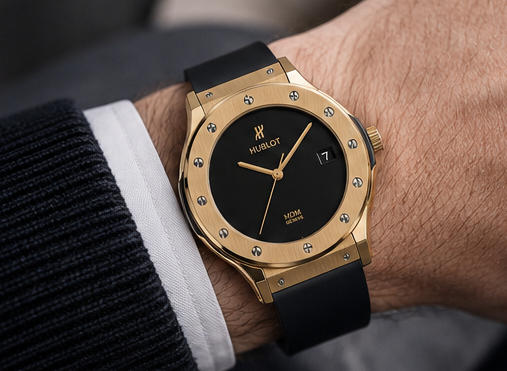
The bezel is the clearest link with Hublot’s early watches. Modern Classic Fusion models usually use six H-shaped screws, while the Tributo returns to twelve rounded screws arranged around the bezel. That immediately gives the front of the watch a different rhythm. Because the dial itself is deliberately sparse, the bezel screws become part of the visual structure rather than simply decorative hardware.
The black dial continues the same idea. There is very little on it beyond the hands, date window and MDM signature at six o’clock. That restraint is important because it allows the proportions of the watch to do most of the work. The Tributo does not rely on texture, oversized numerals or complicated finishing to create interest. Instead, the contrast between the dark dial, precious-metal case and black rubber strap becomes the design.
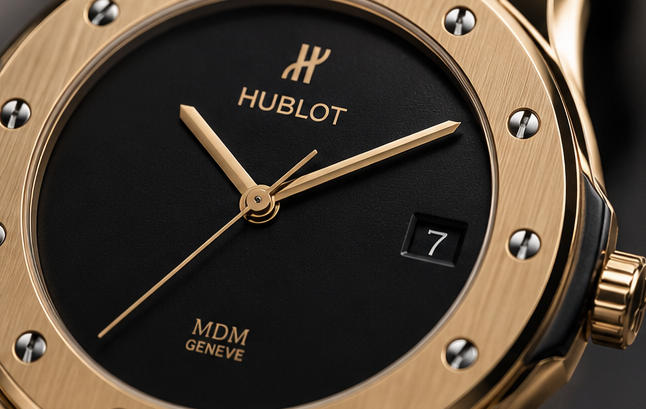
This is one reason the watch is more difficult to reproduce convincingly than its simple appearance might suggest. On a busy chronograph, a small error in one part of the dial can disappear among several other elements. On the Tributo, there is nowhere for an inaccurate proportion to hide. A bezel that sits too high, screws that are too large or a date aperture placed slightly too far inward can change the appearance of the entire watch.
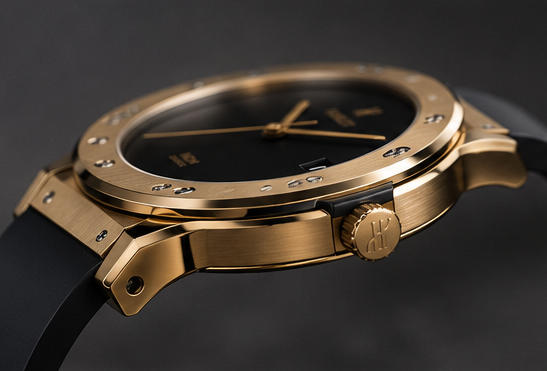
A Hublot Classic Fusion Tributo replica with the correct bezel layout therefore needs more than a recognisable outline. Screw position, bezel width and the way the lugs emerge from the case all have to work together. The exposed strap attachment is especially important because Hublot deliberately avoided adapting the newer One Click system. That decision helps the Tributo retain the slightly rawer construction of the original watch.
The rubber strap deserves more attention than it usually receives. On many watches, the strap is an accessory that can be changed without altering the basic identity of the case. Here, it is part of the concept. Without the black rubber, the yellow-gold version would lose much of the contrast that made the original Hublot feel unusual in 1980.
I think this is also why the yellow-gold version makes more immediate sense than the white-gold model. Yellow gold creates the strongest visual contrast with the rubber and therefore communicates the historical idea more clearly. The white-gold version is quieter and perhaps more versatile, but it feels slightly more like a modern interpretation than a direct reference to Hublot’s beginning.
The genuine models use 18K yellow gold or 18K white gold, and that distinction becomes important when replica versions are compared. A similar surface colour does not mean the same material has been used. Coated steel can reproduce the appearance reasonably well in photographs, but the weight, surface response and way the case ages will be different. That is one of the areas where studio photography can make two watches appear closer than they really are.
The Automatic Movement Changes More Than the Specification Sheet
The most significant change from the original watch is inside the case. The first Hublot used quartz, which made sense in the period and also helped keep the watch thin. The Tributo uses the automatic HUB1711 instead, giving the modern version a mechanical identity that fits much more naturally with the way Hublot is positioned today.
The HUB1711 is based on Zenith Elite architecture and provides approximately 50 hours of power reserve. Hublot also exposes the movement through the sapphire case back, where the openworked rotor introduces a more contemporary touch. This is the point where the Tributo stops being a nostalgic recreation and becomes a modern watch built around an old idea.
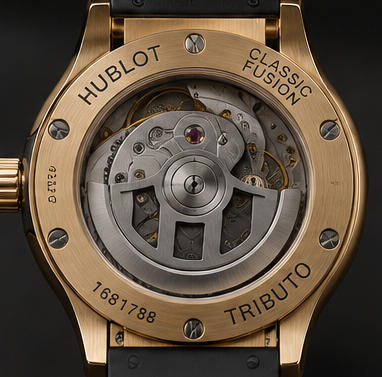
That difference matters because the movement changes the way the case has to be designed. A quartz watch can be extremely thin and simple internally. An automatic movement requires more space, a rotor and a different internal architecture. The fact that the Tributo still retains a relatively restrained profile is therefore part of what makes the modern interpretation successful.
This is also where replica comparisons need to be handled carefully. A visible automatic movement can be decorated to resemble the genuine watch, but engraving and an H-shaped rotor do not make it equivalent to HUB1711. A Classic Fusion Tributo replica movement seen through the case back should be judged by its architecture, bridge positions, rotor construction and overall depth rather than decorative similarity alone.
Case thickness becomes just as revealing. Two watches can both be advertised as 38mm while wearing very differently if one has a deeper mid-case or thicker case back. On the Tributo, this matters because the watch is supposed to feel like a restrained early Hublot rather than a compact Big Bang.
The same principle applies to the strap and clasp. A rubber strap that is too stiff can make the watch sit awkwardly, while incorrect taper or attachment points can change the balance of the case. These details are easy to ignore in front-facing product photographs, but they become far more obvious once the watch is seen from the side or worn on the wrist.
Readers looking through our Hublot Classic Fusion replica watches coverage should therefore avoid concentrating on the dial alone. Case profile, screw placement, rubber strap proportions and movement presentation are all more useful comparison points than broad seller descriptions.
Why Going Backwards Works for Hublot
The most successful part of the Tributo is that Hublot resisted the temptation to overcomplicate it. An anniversary model could easily have become another exercise in exotic materials, large dimensions or highly visible mechanics. Instead, the watch works by reminding us that Hublot’s identity began with one very simple contrast.
Gold and rubber no longer seem strange together, but that familiarity is part of the story. What once looked unconventional has become normal enough that it is easy to forget why the original watch mattered. The Tributo brings that point back into focus without trying to force the design into a vintage shape that no longer suits the brand.
The move from 36mm to 38mm is a good example. It respects the original scale while acknowledging that Hublot’s modern audience expects slightly more presence. The use of an automatic movement does something similar. It changes the mechanical character completely, but it also makes the watch feel like a serious modern Hublot rather than a literal anniversary reproduction.
There is a useful lesson here for replica comparisons as well. The Tributo shows that recognisable branding is not enough. A replica can carry the right logo, approximate case shape and black rubber strap and still miss the reason the design works. Balanced proportions, correct bezel geometry, restrained dial treatment and the relationship between the case and strap are what make the genuine watch coherent.
That is why I find this release more interesting than many anniversary watches. It is not trying to recreate the past perfectly, and it does not need to. Hublot has taken the original idea, adjusted the dimensions, introduced a mechanical movement and refined the finishing while leaving the central concept intact.
More than four decades after Hublot first combined gold with rubber, that pairing no longer feels provocative. It simply looks like Hublot. In a way, that may be the strongest evidence that the original idea succeeded.
 admin